← Independent product builds
Duplicate Song Remover
A desktop product that scans a music library, builds explainable duplicate candidates and helps the user resolve them through a safe quarantine workflow rather than irreversible deletion.
- Role
- Product lead and hands-on builder
- State
- Release candidate packaged for Windows
- Proof
- Packaged release candidate
01 Problem
Why this deserved a product
Duplicate tracks are rarely exact copies. File names, metadata, folders and audio content can disagree, while a wrong deletion is costly and difficult to reverse.
Product decision
Treat duplicate detection as a confidence-building workflow—not a single yes/no algorithm. Multiple signals create candidates; stronger comparison and user review determine the action.
02 Product mechanism
How the system behaves
The useful part is the operating sequence—not the screen alone.
- 01
Scan the library and normalise track metadata.
- 02
Generate candidates using metadata, hashes, folder patterns and fingerprint blocks.
- 03
Compare likely matches using Chromaprint-derived audio evidence.
- 04
Persist decisions so repeated scans remain understandable.
- 05
Move selected files to quarantine before permanent removal.
03 Product tensions
Trade-offs made explicit
Each build is a negotiation between competing forms of value.
04 Working surfaces
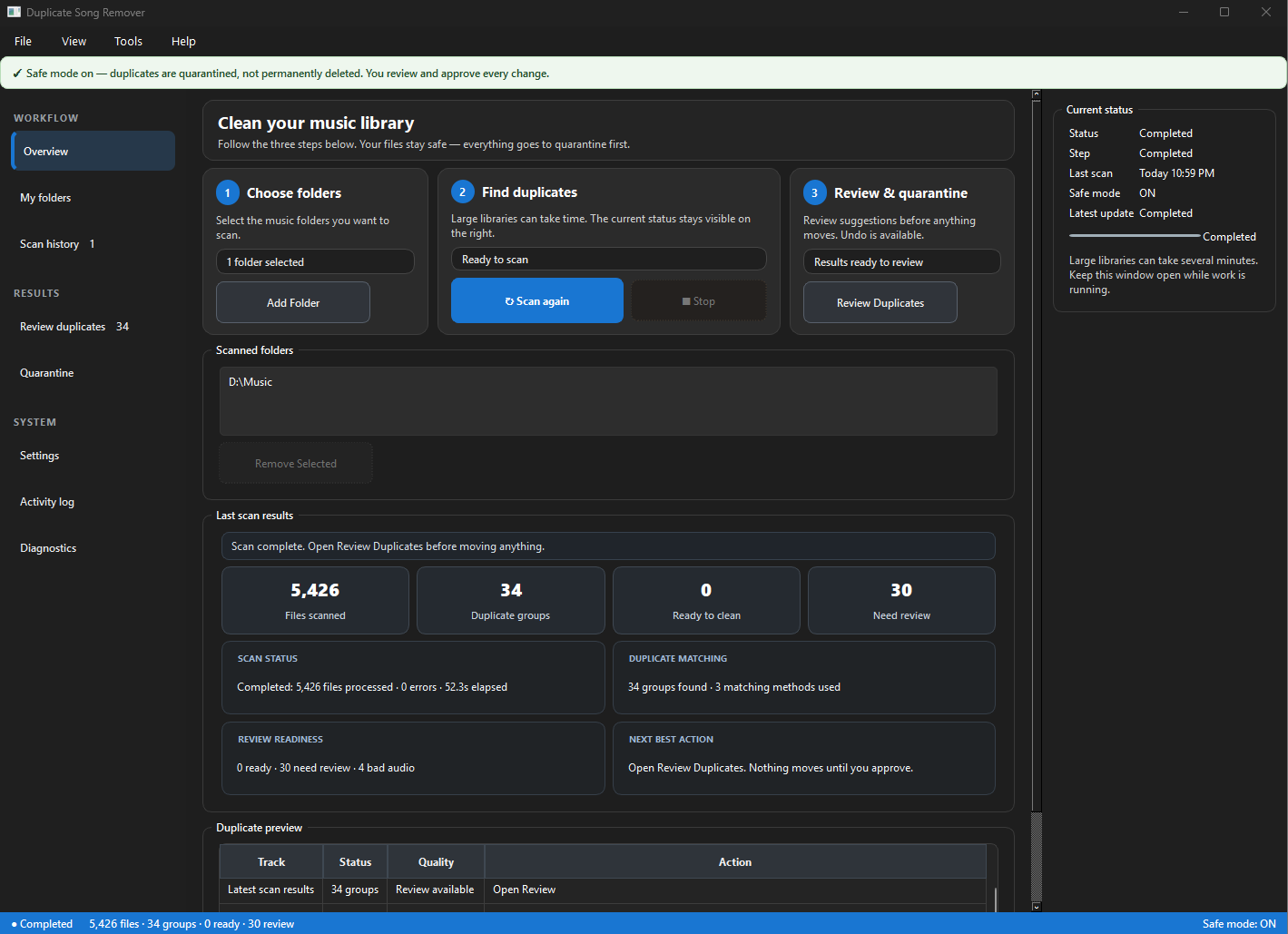
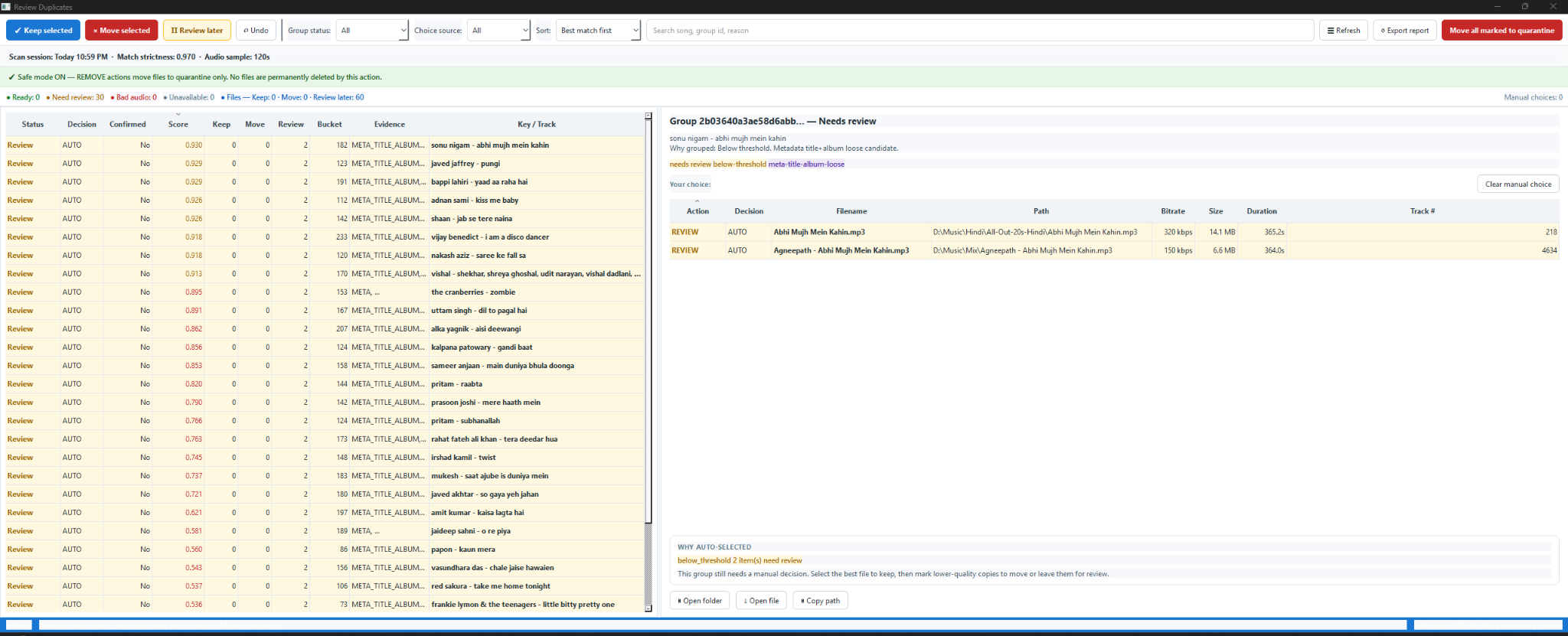
Screens from the build itself
Real product surfaces are included where public sharing is possible.
These screens show the current product state being referenced on this page. They support the product record but do not, on their own, claim user or business outcomes.
05 Build and evidence
Technical surface
Stack
Python 3.13PySide6SQLiteChromaprint / fpcalcWindows packaging
Current proof position Packaged release candidate
The evidence below separates implemented product state, supporting artifacts and proof that is still pending.
Evidence ledger
What exists, what it supports and where the claim stops.
Verified state Available artifact Planned proof
Working product Verified state
Working resolution pipeline
- Claim supported
- The product performs the complete library-cleanup workflow rather than presenting a static interface concept.
- Evidence detail
- Scanning, candidate generation, comparison, persisted decisions and quarantine are implemented as one operating sequence.
- Source
- Application source and repeatable local smoke tests
Release evidence Verified state
Windows release-candidate packages
- Claim supported
- The build has crossed from development source into distributable desktop packages.
- Evidence detail
- Version 0.4.1 was packaged as an installer and portable ZIP, with the accepted unsigned release-candidate state recorded.
- Source
- Installer package, portable package and release checklist
Product capability Available artifact
Explainable duplicate decisions
- Claim supported
- Users are not asked to trust a single opaque match result.
- Evidence detail
- Metadata, hashes, folder context and acoustic fingerprint evidence contribute to candidate confidence and review.
- Source
- Candidate-building and decision-persistence implementation
Public proof Planned proof
Public walkthrough and sample library
- Claim supported
- A visitor should be able to inspect the workflow without using a personal music library.
- Evidence detail
- The planned package will combine a short walkthrough, anonymised scan output and a controlled demo library.
- Source
- Planned evidence package
06 Release trail
From intent to working state
A build becomes credible through the sequence of decisions it survives.
- 01 Detection pipelineComplete
Metadata, hash, folder and fingerprint candidate paths implemented.
- 02 Safety modelComplete
Quarantine replaces immediate destructive deletion.
- 03 Desktop release candidateComplete
Installer and portable 0.4.1 RC packages completed.
- 04 Public demonstration layerNext
Walkthrough, sample library and public release notes remain to be added.
07 Current state
Where the product is now
Version 0.4.1 release candidate completed with installer and portable packages; core smoke tests passed.
Next evidence to add
- 01Short product walkthrough video
- 02Anonymised sample scan report
- 03Public release notes and downloadable demo library
Continue exploring